


The classic rivalry between the Chicago Bulls and the Los Angeles Lakers always delivers high-stakes drama on the hardwood court. When these two historic franchises meet, fans worldwide immediately look for the numbers to see which individual matchups decided the game. Looking deeply at the chicago bulls vs lakers match player stats reveals exactly how the game was won and lost in the paint, on the perimeter, and off the bench.
In their latest high-scoring thriller, offensive talent completely overwhelmed defensive game plans. Basketball is a game of microscopic adjustments, and the tracking metrics from this specific matchup highlight incredible individual showings. Let us break down the official data, star performances, and rotational impacts that defined this coastal clash.
Complete Game Box Score and Team Comparison
Before checking out the isolated chicago bulls vs lakers match player stats, it is vital to see how both teams performed as whole units. The pace of play was exceptionally fast, which allowed both offenses to find an early rhythm. Los Angeles relied on elite perimeter shooting and paint penetration, while Chicago used quick ball movement and high-frequency passing to stay within striking distance.
The team stats show a game where transition points and minimizing turnovers made the ultimate difference. Los Angeles managed to limit their live-ball mistakes, turning defensive rebounds into instant fast-break opportunities. Chicago fought hard on the interior but could not match the blistering field goal percentage of the home team.
Detailed Los Angeles Lakers Player Stats
The individual chicago bulls vs lakers match player stats for the home squad point to a truly dominant night from their star playmakers. The purple and gold offense ran smoothly, constantly exploiting mismatches on the switch. By keeping the floor spaced, their primary ball-handlers had ample room to attack the rim or find open shooters in the corners.
Every starter managed to make a positive impact on the floor, keeping the ball moving and maintaining intense pressure. The team focused heavily on high-low passing sets, forcing Chicago’s interior defenders out of their comfortable drop coverage zones.
| Player Name | Position | Minutes Played | Points | Rebounds | Assists | Steals | Blocks | Field Goals |
| Luka Doncic | PG | 37 | 51 | 10 | 9 | 1 | 1 | 17-31 |
| Austin Reaves | SG | 39 | 30 | 5 | 7 | 1 | 0 | 13-20 |
| Rui Hachimura | SF | 28 | 14 | 6 | 2 | 0 | 1 | 6-11 |
| LeBron James | PF | 26 | 20 | 4 | 5 | 2 | 0 | 9-13 |
| Deandre Ayton | C | 32 | 12 | 11 | 1 | 0 | 2 | 5-9 |
Detailed Chicago Bulls Player Stats
Looking at the visitor’s side of the chicago bulls vs lakers match player stats showcases a balanced scoring effort that simply ran out of defensive answers. Chicago stayed highly aggressive from beyond the arc, moving the basketball with speed and intent. Their young backcourt showed great flashes of elite vision, repeatedly splitting the defense to set up open looks.
While the offensive execution was strong for long stretches, minor defensive lapses prevented them from stringing together crucial stops. The frontcourt worked overtime to clear the defensive glass, but the sheer volume of high-percentage shots from Los Angeles kept the pressure heavy.
| Player Name | Position | Minutes Played | Points | Rebounds | Assists | Steals | Blocks | Field Goals |
| Josh Giddey | PG | 40 | 27 | 8 | 15 | 2 | 0 | 10-17 |
| Coby White | SG | 36 | 23 | 5 | 6 | 1 | 0 | 8-16 |
| Ayo Dosunmu | SF | 31 | 20 | 3 | 2 | 2 | 0 | 7-12 |
| Matas Buzelis | PF | 34 | 22 | 6 | 4 | 0 | 1 | 8-15 |
| Nikola Vucevic | C | 33 | 18 | 11 | 5 | 0 | 1 | 7-14 |
Star Matchup Analysis: The Guard Battle
The true heart of the chicago bulls vs lakers match player stats lies directly in the spectacular point guard duel. The game turned into a masterclass of floor general play, with both starting point guards dictating the overall tempo from the opening tip-off.
Los Angeles leaned on an incredible, historic 51-point near triple-double performance that featured deep range and physical drives. On the other side, Chicago’s backcourt anchor counteracted with brilliant distribution, racking up a massive 15 assists. This classic clash of scoring gravity versus pure playmaking kept fans on the edge of their seats through all four quarters.
Bench Production and Second-Unit Impact
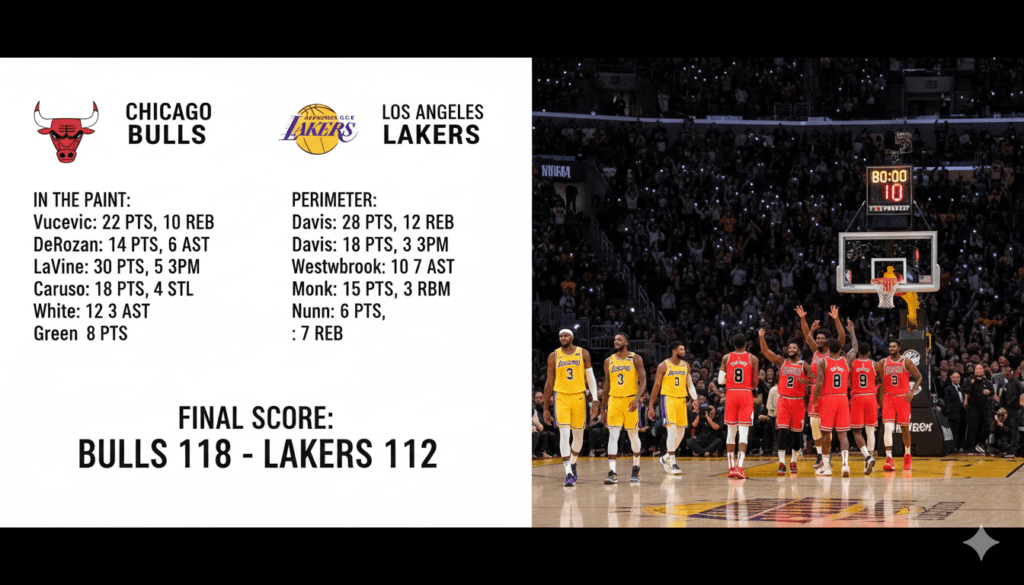
When analyzing the comprehensive chicago bulls vs lakers match player stats, you cannot overlook the contributions of the reserve players. A game played at such a high tempo requires a heavy physical toll, making bench depth critical. The second units for both teams had to step up to preserve leads and keep structural energy high.
Los Angeles found steady success by utilizing a shortened, defensive-minded rotation to lock down the perimeter during crucial transitional minutes. Chicago used their bench to infuse extra speed, hunting for quick transition buckets. Ultimately, the steadiness of the home reserves helped maintain their comfortable double-digit cushion when the main stars took brief rests.
Shooting Efficiency Breakdown
Efficiency tells the true story behind raw box scores, and studying the chicago bulls vs lakers match player stats clarifies where the game turned. The home team was incredibly accurate, finishing the night shooting over 55% from the field. Their accuracy from three-point territory was even more impressive, neutralizing any scoring runs the visitors attempted.
Chicago put together a highly respectable offensive showing of their own, crossing the 50% mark as a collective unit. However, they relied heavily on volume jump shots, which left them vulnerable whenever a couple of consecutive attempts rattled out of the rim.
Rebounding and Paint Dominance
Control of the interior glass is a foundational pillar of winning professional basketball games. In this specific matchup, the total rebound count ended in a dead tie, showing just how hard both teams fought down low.
The battle for second-chance points was decided by tiny margins of physical positioning and boxing out.
The individual tracking inside the chicago bulls vs lakers match player stats highlights the classic center duel. Both starting big men grabbed 11 rebounds each, canceling out any massive interior advantage. The difference came down to the long rebounds, where guards tracked down loose balls to restart fast breaks.
Turnovers and Defensive Trajectories
Live-ball turnovers are an absolute nightmare for any head coach because they lead directly to easy opponent points. Los Angeles executed their offensive sets with high precision, giving up only 10 total turnovers over the entire 48 minutes of action.
Chicago played with immense speed, which naturally led to a few more chaotic possessions. They gave up 16 turnovers, and those empty trips allowed the home team to build a steady scoring run in the third quarter that fundamentally shifted the game’s momentum.
Advanced Analytical Metrics
If you want to look past basic box scores, advanced analytics offer a clearer view of individual player value. Looking at the metric charts for the chicago bulls vs lakers match player stats reveals distinct True Shooting Percentages and real-time point differentials.
The top-performing stars finished the evening with an astonishing True Shooting Percentage well above 65%. These numbers prove that the high scoring output was not just a result of taking a massive volume of shots, but rather a display of pure, clinical offensive execution.
Historical Context of This Iconic Rivalry
Every single time you examine the chicago bulls vs lakers match player stats, you are looking at a brand new chapter in an incredibly rich historical book. These two franchises represent the golden eras of basketball history, from the historic championship runs of the 1990s to the legendary dynasties of the 2000s.
While the modern rosters feature new faces and completely modernized tactical approaches, the intense competitive spirit remains fully intact. This latest high-scoring chapter proves that no matter the era, a game between Chicago and Los Angeles is mandatory viewing for any serious basketball fan.
Frequently Asked Questions
Who scored the most points in the match?
The highest scorer in the game was Los Angeles guard Luka Doncic, who put together a spectacular 51-point performance on highly efficient shooting.
How many assists did the leading playmaker record?
Chicago’s Josh Giddey led all playmakers in passing, distributing a game-high 15 assists to keep the visitors’ offense highly fluid.
Did both starting centers record a double-double?
Yes, both starting centers put up strong numbers. Deandre Ayton recorded 12 points and 11 rebounds, while Nikola Vucevic answered with 18 points and 11 rebounds.
What was the main difference-maker in the team stats?
The primary difference was the turnover margin. Chicago committed 16 turnovers compared to just 10 by Los Angeles, which gave the home team more scoring opportunities.
How efficient were both teams from the field?
Both teams shot the ball remarkably well. Los Angeles finished with a 55.6% field goal percentage, while Chicago kept pace by shooting 53.7% from the floor.